Showing posts with label museum sunday. Show all posts

Sunday, February 2, 2020

Museum Sunday: A French court gown, 1775.

Museum Sunday: a day for highlighting objects, books, and other items from the collections and lives of Marie Antoinette and her contemporaries.

 [credit: Metropolitan Museum of Art]

This stunning floral pink gown, circa 1775, is one of the most exceptoinal examples of existing French court gowns in existence today. Despite the passage of time, the gown has kept much of its colorful vibrancy and unlike many gowns from the 18th century, there are no alterations to make it suitable for fashions decades down the line. The color and floral patterns are similar to those favored by Marie Antoinette, and one can easily imagine the queen sporting a similar gown at court.

The gown is currently not on view, but was displayed in 2004 and then again in 2007 as part of two special exhibitions. More views of the gown and information can be found on the collection page at The Met.

Sunday, January 26, 2020

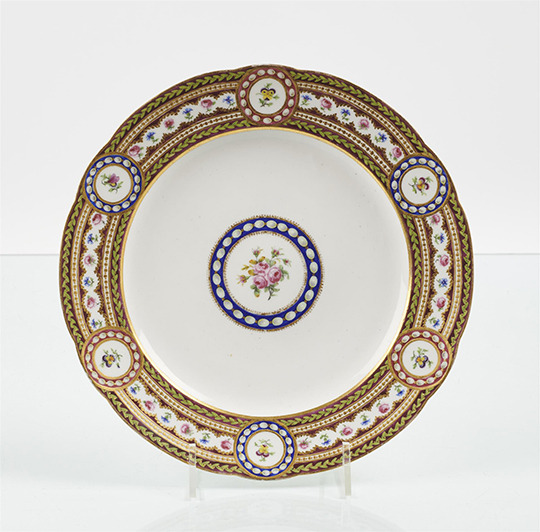
Museum Sunday: A Sèvres plate from a service commissioned by Marie Antoinette

Museum Sunday: a day for highlighting objects, books, and other items from the collections and lives of Marie Antoinette and her contemporaries.


A Sèvres porcelain plate from a 'riche en couleurs et riche en or' service commissioned by Marie Antoinette in 1784. In February of 1784, the director of the Sèvres factory wrote that: "The Queen ... ordered a full service with the dishes. Her Majesty is in a hurry, there are 22 workers working."

During a visit from Gustav III of Sweden, Louis XVI gifted the service to the Swedish king as a diplomatic gift; Sèvres then quickly produced a second service, which was delivered to Marie Antoinette on August 26th, 1784. Pieces from this service are kept in museums and private collections around the world.

Sunday, January 12, 2020

Museum Sunday: A pair of pots from Marie Antoinette's perles et barbeaux service

Museum Sunday: a day for highlighting objects, books, and other items from the collections and lives of Marie Antoinette and her contemporaries.


 [image credit: (C) RMN-Grand Palais (Château de Versailles) / Gérard Blot]

These small pots are part of the most recognizable and popular of all the Marie Antoinette Sèvres services: the perles et barbeaux ("pearls and cornflowers") service, which was commissioned from Sèvres in 1781 and exhibited at Versailles on January 2nd, 1782. The art design is believed to have been done by Michel-Gabriel Commelin and according to RMN, these particular pieces were painted by Jean-Pierre Fumez.

While the exact destination of the original service is unknown, it is generally believed that the service was used for the Petit Trianon due to the simplistic design which matches the aesthetic Marie Antoinette cultivated at her private estate.

Unlike a few other Sèvres designs created for Marie Antoinette which were sometimes repeated for other members of the royal family, the official Sèvres factory perles et barbeaux service was reserved exclusively for Marie Antoinette. However, its design was such an immense success that it was copied by other factories throughout Europe.

The full service consisted of 295 pieces, including 96 plates worth 30 livres each. As of today, the service is scattered around the world in both museums and private collections. These particular pots are in the collection of the Chateau de Versailles.

Sunday, January 5, 2020

Museum Sunday: The Royal Family's Prayer Book

Museum Sunday: a day for highlighting objects, books, and other items from the collections and lives of Marie Antoinette and her contemporaries.


The above book, which was auctioned in 2017, is a prayer book from the collection of Marie Antoinette, which accompanied her and the royal family to the Temple after their imprisonment. According to one of the previous owners, who gifted it to the comte de Chambord, the book’s spine was prone to opening on pages 138, 310, and 364; meaning, these were pages that Marie Antoinette and the royal family frequently returned to during their captivity.

The book has been kept closed for preservation for more than 150 years and has almost entirely lost this feature, but upon inspection for the auction, it was discovered that it still opens to page 310, which includes the passage: 

“Scarcely is he [Jesus] raised to the sight of all these people, that he is insulted, and charged on all sides with curses and reproaches. In the end, he makes one last effort to raise his eyes to Heaven: My Father, he exclaims, forgive them, I pray you, because they know not what they do.”

One can easily imagine the royal family finding meaning and comfort from this particular passage. 

Sunday, June 30, 2019

Museum Sunday: Folding stool for Marie Antoinette's gaming room

Museum Sunday: a day for highlighting objects, books, and other items from the collections and lives of Marie Antoinette and her contemporaries.

Jean-Baptiste-Claude Sené (French, 1748 - 1803, master 1769)
Pair of Folding Stools (pliants), about 1786, Gessoed, painted, and gilded beech; modern upholstery
41.3 × 72.4 × 53.3 cm (16 1/4 × 28 1/2 × 21 in.), 71.DA.94
The J. Paul Getty Museum, Los Angeles


Marie Antoinette love for gambling has become infamous, and this folding stool, now owned by the Getty Museum, was privy to many games played in Marie Antoinette's apartments at the chateaus de Fontainebleau and Compiegne. This stool was one of 64 ordered for use between the two palaces; they were delivered along with 12 matching fixed leg stools, a folding screen and a fire screen. They were originally covered with painted satin. The folding design made it possible for the stools to be transported from room to room, or even palace to palace if necessary, by simply removing the cushion.

The original stools were purchased at 720 livres each. In 1792, after the fall of the monarchy, they were integrated into the collection of the new French government. In 1797, some of the stools were transported to the Tuileries and palais du Luxembourg for use in the emperor's apartments. Today, the remaining folding stools are scattered throughout museums and private collections.

Sunday, March 10, 2019

Museum Sunday: A bowl used by Louise de France, the 8th daughter of Louis XV

Museum Sunday: a day for highlighting objects, books, and other items from the collections and lives of Marie Antoinette and her contemporaries.


This decorated porcelain bowl was created in 1764 for Louise-Marie de France, the 8th daughter and youngest of Louis XV and Maria Leszczyńska's children. Louise, along with three of her sisters, was sent as a young child to the Abbaye de Fontevraud  to live as a boarder due to the Cardinal de Fleury's efforts in cutting royal expenses. Madame Campan would later recall ;Mesdames' memories of their childhood at the abbey as being particularly frightful and, in terms of education, neglected; Madame Louise, Campan wrote, claimed that she could hardly read at the age of 12 and it was not until she was allowed to return to Versailles at the age of 13 that she learned to effectively read.

Louise's life at Versailles was much grander than at the abbey, and while she and her sisters threw themselves into their studies and the companionship of their brother the then-Dauphin, the yrecived little affection from their father. Louis XV notoriously referred to his children with teasing nicknames--he referred to Louise as "Rubbish."

A courtier later wrote of Louise that she of all the sisters was "passionately fond of every pleasure, was something of a glutton, very fond of dress, incapable of living without every new invention of luxury, had a lively imagination and great leaning to coquetry." This ornate bowl, unusually decorated with both Louise's monogram and the coat of arms for an unmarried French royal princess, would have fit in well with Louise's then-love for worldly pleasures. Louise would have typically sipped bouillon and other light broths from the bowl, either in between meals or on days when she preferred something light.

Coincidentally, the bowl was finished in 1764, a year which marked the beginning of the end of Louise's love for life at Versailles. iIt was in 1764 that Louis XV approved the banishment of Jesuits from France, an act which Louise abhorred. From 1765 to 1768, Louis endured te deaths of close family members, including her beloved brother, his wife, her own mother, and her nephew. In June of 1768, Louise asked the Archbishop of Paris to plead with the king to approve her request to enter into the Carmelites convent at St. Denis.

Sunday, March 3, 2019

Museum Sunday: A dog-shaped lacquer owned by Marie Antoinette

Museum Sunday: a day for highlighting objects, books, and other items from the collections and lives of Marie Antoinette and her contemporaries.

 [credit: Photo:© RMN–Grand Palais/ Art Resource, NY/photo by Thierry Ollivier. Via The Getty.]


This dog-shaped lacquer box is one of the most memorable and popular of the 80 or so Japanese lacquer pieces that Marie Antoinette collected in the 1780s. The initial set of Marie Antoinette's vast Japanese lacquer box collection came as an inheritance from Maria Theresa after her death in 1780; over the next 8 years, Marie Antoinette would purchase 30 additional pieces, including this dog-shaped box. High-end Japanese lacquer boxes were a coveted item in Europe, where they were often passed around private collections and auctioned off in special luxury goods sales.

As for Marie Antoinette, she was so enamored of her little boxes that she redecorated the cabinet doré (or private sitting room) to showcase her collection. This dog-shaped box was not stored in the immense glass cabinet she commissioned to store her pieces, but was highlighted with other favorite objects on smaller tables placed throughout the room. It would have certainly been a conversation starter: a small lacquer box intended for the Japanese upper class that traveled the world to send up in the private apartment of the queen of France.

After the events of October 1789, Marie Antoinette asked Martin Éloy Lignereux, an art dealer whom she trusted, to return to Versailles and pack some of her personal belongings. Among these were her collection of lacquer boxes, which were sent to Paris with the intention of eventually making their way to the queen at the Tuileries. This was never to be, and the queen was never reunited with her treasured boxes. The collection remained with the art dealer until 1794, when he was ordered to surrender them to the new government. Surprisingly, the pieces were not destined for the same fate--destruction or sale--as most of Marie Antoinette's personal belongings. Instead, they were sent to the newly minted Muséum central des Arts, where they remained until just after WWII. In 1965, many of the pieces--including this charming dog box--were returned to the chateau de Versailles collection, which still owns them today.

References and Further Reading

Sunday, February 24, 2019

Museum Sunday: A court doll depicting Marie Antoinette


[image credit: Theriault's]

An 18th-century court doll depicting Marie Antoinette, circa the 1780s. This rare and unique piece is one of the few known French court dolls from this era to have survived. This elaborate doll was made from carved wood with silks and muslin fabric used for the gown. This was not a children's toy, but rather part of an overarching group of adult dolls that were produced in the court of Louis XVI. François Theimer, who completed an extensive study of court dolls during this time period, notes that there are 4 types of representative court dolls made during this period: dolls depicting the royal couple, dolls depicting court figures, dolls made during the Affair of the Necklace scandal, and dolls made during the end of the monarchy. 

This particular doll falls into the first category--a doll depicting the royal couple or in this case, Marie Antoinette herself.

In 2008, this doll was sold at auction. The estimate predicted an $8,000--11,000 selling price; the final realized price was $39,000!

Sunday, February 3, 2019

Museum Sunday: A nightlight owned by the duchesse d'Angoulême

Museum Sunday: a day for highlighting objects, books, and other items from the collections and lives of Marie Antoinette and her contemporaries.


 [image credit: Chez Osenat, via Auction.fr]]

This Sèvres vase-style veilleuse (a type of night light) depicts the pavilion de Breteuil, an estate which had by the time of the painting been integrated into the Chateau de Saint-Cloud. The pavilion de Breteuil was reintegrated into the over-arching estate of the chateau de Saint-Cloud in 1793, when the original owner's property was declared property of the state. This particular veilleuse was purchased on October 2nd, 1822 by the duchesse d'Angoulême for 400 francs. 

Monday, January 14, 2019

Museum Sunday: A spinning top owned by Louis Charles, son of Marie Antoinette and Louis XVI

Museum Sunday: a day for highlighting objects, books, and other items from the collections and lives of Marie Antoinette and her contemporaries.


Louis Charles de France--or Louis XVII--played with this painted wooden spinning top while he and his family were imprisoned in the tower of the Temple in Paris. It was given to Louis Charles by Pauline de Tourzel, the daughter of the governess to the royal children of France, at some point before she and her mother were separated from the family. It was one of several toys that Louis Charles had the option of playing with during his captivity, at least until he was shut up in a solitary cell with little comforts. The top was given to Marie-Thérèse Charlotte after her brother's death and she, in turn, gave it back to Pauline when she was finally allowed to visit the young princess in the Temple. The top remains in a private collection today.

Sunday, January 6, 2019

Museum Sunday: A plate from the perles et barbeaux service

Introducing Museum Sunday: a day for highlighting objects, books, and other items from the collections and lives of Marie Antoinette and her contemporaries.


This plate was created for the most recognizable and popular of all the Marie Antoinette Sèvres services: the perles et barbeaux ("pearls and cornflowers") service, which was commissioned from Sèvres in 1781 and exhibited at Versailles on January 2nd, 1782. The art design is believed to have been done by Michel-Gabriel Commelin. It is generally believed that the service was used for the Petit Trianon due to the simplistic design.


Unlike a few other Sèvres designs created for Marie Antoinette, the official Sèvres factory perles et barbeaux service was reserved exclusively for Marie Antoinette. However, its design was such an immense success that it was copied by other factories throughout Europe.

The service consisted of 295 pieces, including 96 plates worth 30 livres each. As of today, the service is scattered around the world in both museums and private collections.