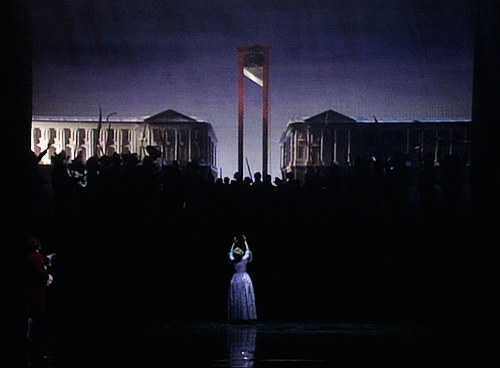
When David Adjmi's Marie Antoinette opened at Soho Rep in 2013, it was a minimized departure from the initial productions at the American Repertory Theater and Yale Repertory Theatre. Whereas the show's first incarnations looked like they were plucked from the dreamy "I Want Candy" sequence in Sofia Coppola's Marie Antoinette film, the Soho Rep production pared down the entire set to some chairs, a table or two of macarons, the occasional prop, and an ominous screen with supertitles giving us the wheres and whens of the story.
On the drastic slimming down of Marie Antoinette's stage design for the 2013 Soho Rep production, director Rebecca Taichman had this to say: "I'm fascinated by what less can do and can be, especially when you're doing a play about excess. Now we can get at the core of it--the marrow, not the icing."
This phrase was repeatedly brought to my mind while watching the reunion reading of the Soho Rep production of David Adjmi's Marie Antoinette, hosted on Zoom.
For what could be more representative of that marrow than a Zoom meeting? All character, emotion, stage, setting, costume, reduced to a frontal shot from the shoulders up. Minimized to what we can see on individual screens. A wood alcove with a door behind Fersen. A grey screen behind Louis, revealing nothing. The occasional speaker clash from raised voices, a character name at the bottom of a cropped screen.
This streaming production was directed by Rebecca Taichman, who also directed the 2013 Soho Rep production; the direction works well, keeping characters off-screen until they appear, and allowing the stage directions to remain audio-only made the production seem, on the whole, professional and streamlined.
To be clear to those unfamiliar with the work, Adjmi's Marie Antoinette is not a historical play, despite its use of historical events and people. Attempting to view the play as a representation of the actual historical figures is a fruitless endeavor, and one which makes the play less enjoyable.
The characters, events, and relationships are so separated from reality that there's often no reconciling them with the historical fact or figure. You will not gain insights about the real Louis XVI or Marie Antoinette, except perhaps one that is already known: that she was a public figure to the extreme degree, with all of the benefits and pitfalls that come with that role.
Instead, history here is an impression, used symbolically and interspersed with familiar events and names that a general audience will recognize, though they are not depicted accurately. The fall of the Bastille, Robespierre, the flight to Varennes, Marie Antoinette herself, are all twisted and used to suit the needs of the narrative.
 |
| image: the only costumes that appear in the production; "farmer" disguises for the ill-fated flight to Varennes |
The play was written during the prominence of the “1%/99%” social movement, as well as a significant rise in celeb culture that saw 'social celebs' like the Kardashians take center stage, and its script circles around these themes throughout both Acts: at the pitfalls and vapidness of celebrity culture; at our need to consume and discard people in the spotlight; at the dangerous ignorance that living in a bubble brings; and at the righteous, inevitable backlash from the people who are on the other side of that bubble.
These themes just as true today than they were when the play premiered in 2013. If anything, the swift rise of social media personalities and an increasing focus on the disconnection between the ultra-wealthy and the average person has brought Adjmi's Marie Antoinette--both the play and titular character--even closer to our understanding than before. There's no denying that a meta line about America being a failed experiment feels far more poignant in 2021 than it did in 2013.
While Adjmi's script is at times too repetitive, too flighty or (in Act II) too unbalanced with weighty philosophy that contrasts heavily with the poppier dialogue in Act I, the performances in this reading bring the script and characters to a high level worthy of introspection--and, with the on demand option, rewatching.
In particular, Steven Rattazzi as Louis XVI brings pathos to Adjmi's childlike stereotype of Louis XVI. His most compelling scene is one that is historically ludicrous: in Adjmi's play, Louis XVI visits Paris and is a personal witness to the fall of the Bastille, returning to Versailles with a Phrygian cap on his head. Accuracy aside, it's a fascinating character scene in which the revolution has been placed literally on top of the passive Louis XVI's head, and Rattazzi's unsure reluctance in confronting what exactly this means--and his desire to have someone, anyone, make a decision for him--is fascinating to watch.
His awkward and subdued Louis XVI is a contrast to Ireland, who snarks and bites and laughs and bustles with the energy that Rattazzi's Louis lacks. His final scene, in which he quietly serenades an infinitely stressed Marie with a song, tears in his eyes, ends with a sad, desperate stare of realization before the entire imprisoned family bursts into painful, stark laughter.
As Joseph II, Karl Miller brings a business-like pomp, glossing over Marie's desire to reminiscence about her childhood and getting straight to the point: when are you going to make an heir? As his second act character Mr. Sauce, Miller portrays an increasingly ominous peasant whose realization that he's talking to the king and queen of France leads to their renewed imprisonment. With a smile that doesn't reach his eyes, it's easy to see why the rest of the characters look as if they wish to back away from the screen in foreboding.
 |
| image: Ireland (Marie) Rattazzi (Louis XVI) and Stack (Fersen). "Actually the public debt has tripled." |
Chris Stack plays Adjmi's version of Fersen, whose primary role is to provide a voice of reason and introspection. The dynamic between Ireland and Stack is intriguing, a sort of constructed easiness that allows Ireland's Marie to open up. When he returns at the end of Act II, in the form of a hallucination, there's a sad poignancy and realization in his eyes that gives the scene a unique bittersweet edge that doesn't come through in the script itself.
Will Pullen makes the most out of Adjmi's sometimes clumsy dialogue as "The Revolutionary," a character which represents not so much "the people" as he does a symbolic culmination of the events that caused the revolution itself. He's the anger, the desperation, the burden, the hunger, rolled into a human body that finds little to reconcile with Marie, even when the two finally engage in meaningful discussion.
As the duchesse de Polignac, Ziles embodies a sort of false vanity, putting on airs to match Marie's bubblegum-popping attitude; this wavers when she attempts to engage with Marie on intellectual subjects, before awkwardly realizing that her companion has no idea what she's talking about. The conversation then immediately delves back into a safer subject: fashion. Like Miller's Mr. Sauce, Ziles' Mrs. Sauce plays an increasingly deceptively sweet woman who, with her husband, ensures that the royal family is not able to escape.
By contrast to Polignac, Ikeda's Lamballe (she also returns
as an exposition-character, a Royalist) wants to engage with Marie on a more real level, offering shrugging advice and reluctantly informing her about some of the nastier rumors going around. She has a warm presence, almost subdued in her attempts to convince Marie to think a bit harder, until bubbling tensions towards the end bring out her frustration.
Kat Elizabeth Williams joined the cast as the Dauphin, or Louis Charles. Williams does well showing the uneasy reaction of a child exposed to larger events outside of their control--the frustration of an annoyed mother who doesn't have time to deal with them, the wariness of frightening strangers, and child-like fear at hearing about a world turned upside down.
Then there is... The Sheep. A symbolic, strange character played here, as in the 2013 Soho Rep production, by David Greenspan. The sheep is not real. The sheep is creepy. The sheep warns Marie about the future and demands to be pet while invading her personal space. While the character itself feels unnecessary--particularly given that the territory Adjmi covers with the Sheep is already covered by the Revolutionary--Greenspan embodies the sheep with an underlying menace that pays off in the end.
And of course, there is Marie herself.
 |
| Marie (Ireland), Lamballe (Ikeda) and Polignac (Ziles). |
Marin Ireland's Marie Antoinette is a marvel to behold. Frenetic, anguished, flippant, despairing, callous, genuine, bursting at the seams of a video square.
Ireland’s performance brims with teetering layers that are peeled away as the show goes on, starting with a frosted pink top of pompous celeb silliness and ending with something pathetic, trapped underneath glass, aching to get out. What exactly that “something” is, neither the audience--nor Marie--truly knows. Nor does she ever really find out.
Some of the more revealing moments of Marie’s gilded-cage come from nostalgia for her childhood at Schönbrunn, a Von-Trapp like existence that she describes as "playing in the mountains, singing songs.” She longs to hear news of her childhood governess. She asks her elder brother if he remembers playing outdoors.
Yet when her childlike longing begins to reveal something more serious underneath, it’s immediately dismissed and not dwelled upon. How could it be, when more important things--like having an heir, like dealing with the revolution--are at stake?
Ireland's blithe like-so-ums in Act I are interspersed with bursts of thoughtfulness, revelations of despair and something like intelligence inside her, only to be plastered over again with the need for distraction, the need to ignore anything serious.
With Ireland, this lack of seriousness projects a shield-like protectiveness. Marie’s frantic revelation to Fersen that she was accosted at the Assembly by a man clad in black, who told her that what she’s now experiencing is nothing, and all this is but a “preamble to your suffering,” is reflected on in a moment of horror before Ireland slaps on a smile, offering Fersen chocolate.
 |
| "I've been having nightmares." A late Act I revelation with Marie and Fersen. |
As Act I goes on, however, it becomes impossible for her to continue in ignorance. And by Act II, Marie is forced to shift gears, trading macarons for poorly thought out escape plans and ciphers.
Adjmi’s script is often quick, quipping, biting or sarcastic or otherwise short. At times, it becomes too repetitive, circling around the same themes without offering anything additional to the audience.
Towards the end of Act II, however, the scenes get longer and more introspective, finally avoiding the glossy cover-ups from Act I to confront the revolution (and the philosophical arguments contained within) for better or worse.
While Act II contains the bulk of the fantastic character scenes in which this cast truly shined, it also tends to drag under the weight of mishmash historical events and increasingly philosophical dialogue that sometimes feels too hamfisted to be successful. I think the script actually benefited from the reading-style production in this respect; dialogue that felt too heavy or when spoken on stage seems to flow better when all we have is an intimate shoulders-up view.
The final scenes of Marie Antoinette in prison with only another character (a Revolutionary, a Sheep, and a dream sequence Fersen, in that order) are the most cerebral and contain some of Adjmi's best dialogue.
Solitude in prison makes Marie chatty, thoughtful, desperate. Ireland plays off well against Pullen's fervent Revolutionary, Greenspan's bizarre and eventually nightmarish sheep, and Stack's deceptively pitying dream!Fersen/Executioner.
It's in these final scenes that the play's call to action hits home.
Does it matter that Marie longs nostalgically for the whimsical version of her childhood home? Does it matter that she was neglected by her mother and married off at 14? Does it matter that Marie feels trapped, pressured, caged in by the world that has made her?
In one of the play's last scenes, in which the Revolutionary is cutting her hair in preparation for her execution, he tells the now captive former queen, who is complaining about lice and scissor cuts on her scalp:
"Poor thing. You act like everything's hurt you and everyone's used you and you're just some sweet sunburnt girl at the beach. You won't look at reality."
The line is both a metaphor for Marie's obliviousness throughout the play (she complains about a gilded cage, while others tell her people are starving) and a meta take on the Marie Antoinette mythos itself, where the titular queen is often painted in pastel colors while the political realities underneath are ignored or glossed over.
"I wasn't raised," Marie desperately tells the Revolutionary towards the end of the play in a bid to make him understand her, as much as it is an last-ditch attempt to understand herself--and as much as it is directed towards the audience, letting us know that Marie is not a fully realized being.
"I was built."
Marie Antoinette is available on demand through August 9th.